Take 15 grams of hydrolysed collagen peptides with 50mg of vitamin C, approximately 60 minutes before rehabilitation exercise. This is the protocol established by Shaw et al. (2017) and supported by subsequent research. The timing relative to exercise is critical — collagen without the exercise stimulus shows limited tendon benefit.
Food sources of gelatin (bone broth, slow-cooked meats, jello) can substitute for supplements but are harder to dose accurately. If using supplements, hydrolysed collagen peptide powder is the most practical form.
The Evidence
The foundational study for this protocol is Shaw et al. (2017), published in the American Journal of Clinical Nutrition. The researchers found that participants who consumed 15 grams of vitamin C-enriched gelatin 60 minutes before a rope-skipping exercise protocol showed significantly increased markers of collagen synthesis — specifically, elevated blood levels of the N-terminal propeptide of procollagen (PINP) — compared to those who consumed a placebo or a lower dose.
The key finding was the dose-response relationship: 15 grams produced a significantly greater collagen synthesis response than 5 grams. And critically, the synthesis response was only meaningful when combined with exercise — collagen taken without mechanical loading of the tendon showed a blunted response. The tendon needs both the nutritional substrate and the mechanical stimulus to remodel effectively.
Subsequent work by Baar (2019) and Lis & Baar (2019) reinforced and refined the Shaw findings, confirming that hydrolysed collagen peptides produce a similar response to gelatin, and that vitamin C is a necessary co-factor — not optional. A 2024 systematic review in the German Journal of Sports Medicine confirmed that collagen peptide supplementation combined with exercise produces measurable effects on musculoskeletal connective tissue remodelling across multiple study designs.
Why Vitamin C Matters
Vitamin C is not a passive addition to the collagen supplement — it is a required co-factor in the hydroxylation of proline and lysine residues during collagen synthesis. Without adequate vitamin C, the collagen molecule cannot form properly. The amino acids that make up collagen (primarily glycine, proline, and hydroxyproline) require vitamin C-dependent enzymes to assemble into stable triple-helix structures.
This is why scurvy — severe vitamin C deficiency — produces connective tissue breakdown. It is not that vitamin C is uniquely "good" for tendons; it is that collagen synthesis literally cannot proceed without it. In the context of supplementation, the Shaw protocol used 50mg alongside the collagen dose — a modest amount that ensures the co-factor requirement is met without excessive supplementation.

50mg of vitamin C is a modest dose easily achieved through diet — roughly half an orange, a kiwifruit, or a small serve of capsicum. If your diet regularly includes fresh fruit and vegetables, a separate vitamin C supplement may not be necessary. The key is ensuring adequate vitamin C is present at the time the collagen is consumed and being synthesised.
The Protocol
The protocol derived from the research is straightforward. The critical variables are dose, vitamin C co-administration, and timing relative to exercise.
During the non-weight-bearing phase, "exercise" includes isometric contractions, ankle pumps, and upper body work — not just walking or running. Taking collagen before any rehabilitation session that loads the tendon, however modestly, is worthwhile. As you progress into more active rehabilitation, the collagen-exercise timing becomes increasingly important.
Types of Collagen Supplement
The supplement market for collagen is large and confusing. The most important distinction for tendon healing is between hydrolysed collagen (also called collagen peptides or collagen hydrolysate) and other forms.
Hydrolysed collagen / collagen peptides — the form used in the clinical research. The collagen protein is broken down (hydrolysed) into shorter peptide chains that are absorbed more readily in the gut. These peptides — particularly Pro-Hyp and Hyp-Gly dipeptides — accumulate in connective tissues and stimulate fibroblast activity. This is the form to use.
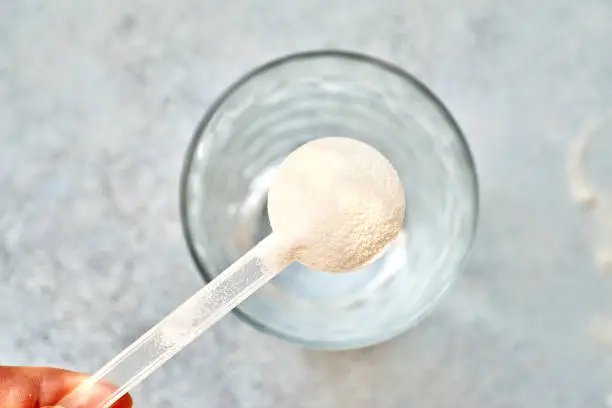
Gelatin — what Shaw et al. originally used. Gelatin is partially hydrolysed collagen — it gels when cooled. It works but is less practical than collagen peptide powder, which dissolves in cold liquid. Bone broth is a food source of gelatin but the collagen content varies significantly and is difficult to dose accurately.
Type I vs Type II vs Type III collagen — tendons are primarily Type I collagen. Most bovine and marine collagen supplements are predominantly Type I. Type II collagen is associated with cartilage rather than tendons. For Achilles recovery, Type I is the relevant form — which is what most collagen peptide supplements provide.
Marine vs bovine collagen — both are predominantly Type I and both have been used in research. Marine collagen may have slightly better bioavailability, but the practical difference is modest. Either is appropriate. Choose based on dietary preferences — marine collagen is suitable for pescatarians; bovine is not suitable for vegetarians or vegans.
What to Buy
You do not need an expensive branded collagen supplement. The evidence does not support one brand over another — the key variables are that it is hydrolysed, that it is taken with vitamin C, and that it is taken before exercise.
Look for a supplement that provides at least 15 grams of hydrolysed collagen peptides per serving, is unflavoured or lightly flavoured (making it easy to mix into water or juice), and has minimal additional ingredients.
Honest Limitations
The evidence for collagen supplementation in tendon healing is promising — but it is not conclusive at the level of clinical outcomes. The Shaw study and its successors measured biomarkers of collagen synthesis (PINP in blood), not actual tendon structure or long-term function. The assumption is that increased collagen synthesis leads to better tendon healing — which is biologically sound — but direct clinical evidence for improved patient outcomes after Achilles rupture specifically is still limited.
A 2024 systematic review of collagen supplementation on tendon structural and performance outcomes noted that while the mechanistic evidence is strong, the clinical outcome data remains variable. Some trials show measurable improvements in tendon properties; others show effects that are smaller than expected. The heterogeneity of protocols, populations, and outcome measures makes definitive conclusions difficult.
The practical implication: collagen supplementation is a reasonable, low-risk addition to a rehabilitation programme. It is not a substitute for progressive loading, adequate protein, or a well-structured rehabilitation protocol. Think of it as supporting the conditions for healing rather than driving healing independently.
Food Sources of Collagen
For those who prefer a food-first approach, the following provide significant amounts of collagen precursors and gelatin:
Bone broth — slow-simmered bones release gelatin and collagen peptides into the liquid. Quality and collagen content vary significantly between products. Homemade bone broth from well-simmered joints (12+ hours) will contain more gelatin than commercial broths.
Slow-cooked meats — cuts with significant connective tissue (oxtail, brisket, shin, chicken legs, pork shoulder) release gelatin during long cooking. Braising and slow cooking are more effective than grilling or roasting.
Skin-on chicken — chicken skin contains high concentrations of Type I collagen. Consuming the skin rather than discarding it provides a meaningful collagen source.
Fish with skin — fish skin is rich in marine collagen. Salmon skin, sardines eaten whole, and similar are good sources.
The limitation of food sources is dosing accuracy — it is difficult to know how much collagen you are consuming compared to a standardised supplement. If you rely on food sources, combining them with a vitamin C-rich food at the same meal (a glass of orange juice, berries, kiwifruit) covers the co-factor requirement.