General information only — not medical or legal advice. The Achilles Hub does not recommend specific surgeons and cannot verify the credentials or outcomes of individual practitioners. Use the AOA directory and consult your GP for referral guidance. About this site →
Finding a Surgeon

How to Find the Right Surgeon for Achilles Repair in Australia

Why surgeon volume and subspecialisation matter, what credentials to look for, and the specific questions to ask at your first consultation — including the ones most patients never think to ask. Includes directories for Australia, the UK, the US and Canada, and New Zealand. General information only.

Last reviewed: April 2025
Reading time: 10 min
Australian context
General information only — not medical advice

Why Surgeon Volume Matters

You can definitely tell the difference between a surgeon who does 50 of the operations a year and one who does 5.
Operating theatre technician — surgical instrument technician with direct observation experience across multiple surgeons and procedure types. Shared with The Achilles Hub.

This observation from inside the operating theatre reflects one of the most consistently replicated findings in surgical research: the volume-outcome relationship. The more frequently a surgeon performs a specific procedure, the better their outcomes across almost every measured metric.

A study using the American Joint Replacement Registry covering 2012–2017 found considerably greater complication rates — including infection, instability, and 90-day mortality — when orthopaedic procedures were performed at low-volume hospitals by low-volume surgeons compared to high-volume settings. The authors concluded that directing complex orthopaedic procedures to high-volume surgeons is warranted by the evidence.

For Achilles tendon repair specifically, volume translates to refined expertise in several critical technical areas:

  • Tendon end approximation — precisely bringing the torn tendon ends together at the correct tension is the most important technical element of the repair. Too loose and the tendon heals elongated, causing permanent weakness. Too tight and range of motion is compromised. This judgement is refined by repetition
  • Suture technique selection and execution — Krackow, Kessler, and other techniques each have different strength profiles and rehabilitation implications. A high-volume surgeon selects and executes the appropriate technique with confidence
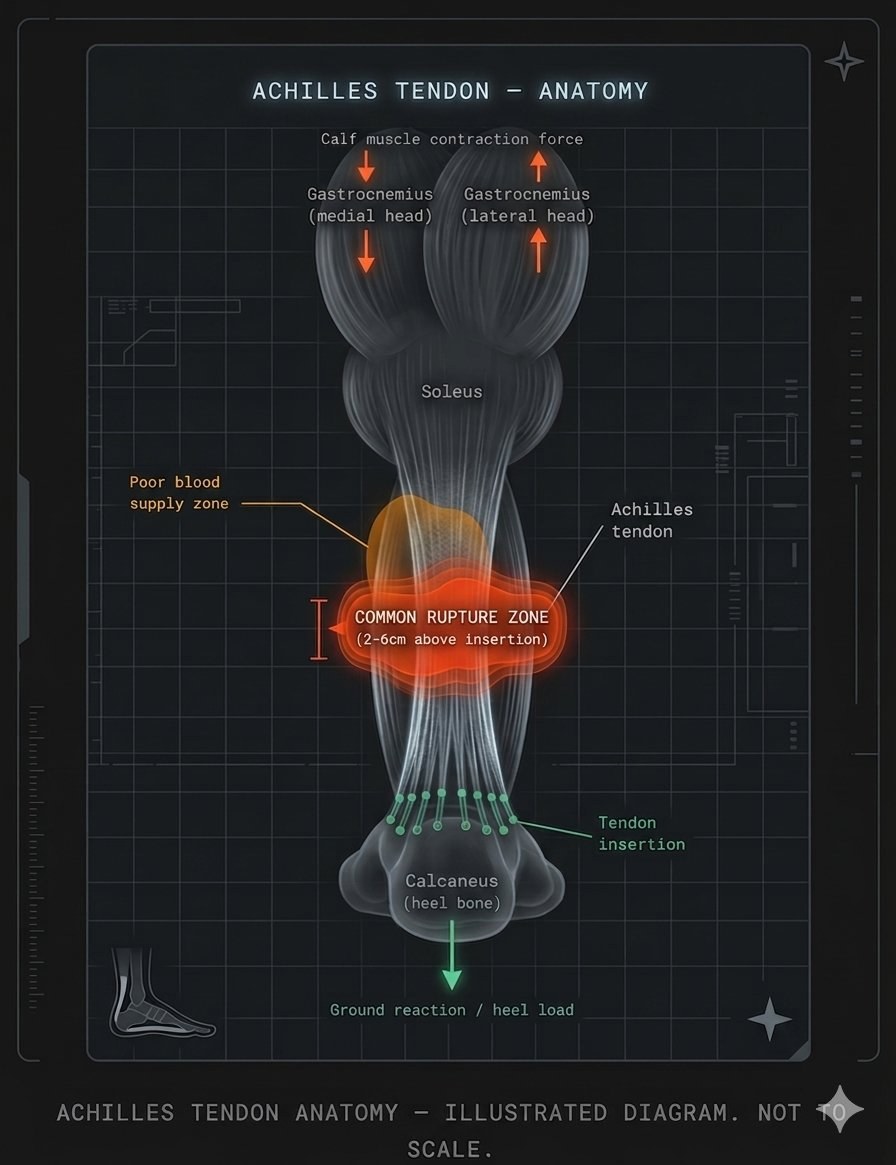
  • Wound management — the Achilles has notoriously poor blood supply, making wound healing a genuine risk. High-volume surgeons develop specific techniques to manage this — incision placement, tissue handling, closure approach
  • Complication recognition and management — a surgeon who has done 50 repairs has seen and managed the full spectrum of complications. One who has done 5 may not have encountered some of them at all
Volume is not a guarantee — but it is a meaningful signal.

A high-volume surgeon is not automatically better than a lower-volume one — individual skill, ongoing education, and commitment to best practice all matter. But volume is the most reliably measurable proxy for experience, and it is entirely reasonable to ask a surgeon directly how many Achilles repairs they perform per year. A surgeon who answers specifically and confidently — "around 40–50 per year" — is giving you meaningful information. One who deflects or is vague is also giving you information.

What Subspecialisation to Look For

Orthopaedic surgery covers a wide scope — hip, knee, spine, shoulder, hand, foot and ankle, paediatrics, and more. A general orthopaedic surgeon manages all of these. A foot and ankle subspecialist has completed additional fellowship training specifically in the anatomy, pathology, and surgical management of the foot and ankle — and concentrates their practice there.

For an Achilles tendon rupture, the subspecialist you want is a foot and ankle orthopaedic surgeon — specifically one who has completed a recognised foot and ankle fellowship. This typically means 1–2 years of additional training after completing general orthopaedic training, often internationally.

The two relevant professional bodies in Australia are:

  • Australian Orthopaedic Association (AOA) — the peak professional body for orthopaedic surgery in Australia. All practising orthopaedic surgeons in Australia should be Fellows of the Royal Australasian College of Surgeons (FRACS) with an orthopaedic subspecialty designation
  • Australian Orthopaedic Foot and Ankle Society (AOFAS) — the AOA subspecialty group for foot and ankle surgeons. Membership indicates subspecialty interest and typically subspecialty training in foot and ankle surgery

Orthopaedic Surgeon vs Podiatric Surgeon — What's the Difference?

In Australia, both orthopaedic surgeons and podiatric surgeons can perform foot and ankle surgery, including Achilles tendon repair in some cases. Understanding the difference helps you ask the right questions.

Foot & Ankle Orthopaedic Surgeon
  • Qualified medical doctor (MBBS or equivalent)
  • Completed general surgical training (FRACS)
  • Completed orthopaedic surgery training (FRACS Orth)
  • Completed foot and ankle fellowship (1–2 years additional)
  • Can manage the full spectrum of complications including vascular, neurological, and systemic
  • Has operating hospital privileges across all major private and public hospitals
  • The standard referral pathway for acute Achilles tendon rupture in Australia
Podiatric Surgeon
  • Not a medical doctor — degree in podiatric medicine
  • Completed postgraduate surgical training in foot and ankle specifically
  • Scope of practice concentrated exclusively on foot and ankle
  • May perform Achilles tendon procedures — confirm scope with individual practitioner
  • Hospital privileges vary — not all hospitals credential podiatric surgeons for this procedure
  • For acute Achilles rupture, an orthopaedic surgeon is typically the standard referral pathway

This comparison is for general information only. Individual practitioners vary significantly. Your GP will direct you to the appropriate specialist for your specific situation.

How to Find a Foot & Ankle Surgeon — By Country

Australia AOA Find a Surgeon
The Australian Orthopaedic Association maintains a public surgeon directory. Search by state and filter for Foot & Ankle subspecialty.
Select your state → Specialty: Foot & Ankle
Western Australia: also check waofas.org.au
United Kingdom BOFAS Patient Portal
The British Orthopaedic Foot and Ankle Society (BOFAS) maintains a patient portal with a Find a Surgeon tool covering NHS and private foot and ankle surgeons across the UK.
Go to bofas.org.uk → Patient Portal → Find a Surgeon
In the NHS pathway, your GP will refer you via the NHS e-Referral Service (e-RS). Ask specifically for a foot and ankle subspecialist, not a general orthopaedic surgeon
Private: Top Doctors UK (topdoctors.co.uk) and HCA UK list foot and ankle consultants with filtering by specialty
United States & Canada AOFAS Find a Surgeon
The American Orthopaedic Foot & Ankle Society (AOFAS) maintains a surgeon finder covering the US, Canada, and internationally. The American College of Foot and Ankle Surgeons (ACFAS) has a parallel directory.
AOFAS: aofas.org/find-a-foot-and-ankle-orthopaedic-surgeon — search by zip code, city, state or country
FootCaremd.org: footcaremd.org — AOFAS patient information site with surgeon search
ACFAS: acfas.org — American College of Foot and Ankle Surgeons, 7,800+ members
Canada: Canadian Orthopaedic Association (coa-aco.org) — Find a Surgeon tool
New Zealand NZOA and ACC pathway
In New Zealand, Achilles rupture is typically an ACC-covered injury — ACC funds surgical management for eligible patients. Your GP or emergency department will initiate the ACC claim and referral pathway.
New Zealand Orthopaedic Association: nzoa.org.nz — surgeon directory
ACC: acc.co.nz — covers treatment costs for injury including Achilles rupture
Ask your GP for a referral to a foot and ankle subspecialist — specify this rather than accepting a general orthopaedic referral
Don't let surgeon research delay your initial assessment.

Get assessed first — ideally in an emergency department or urgent orthopaedic clinic — even if that surgeon isn't your eventual choice for the operation. You can seek a second opinion or transfer care to a preferred subspecialist after initial assessment. Delaying assessment in favour of finding the "right" surgeon can cost you surgical options.

Open vs Minimally Invasive Repair — What to Know

Two main surgical approaches are used for Achilles tendon repair. Understanding the tradeoffs helps you have a more informed conversation with your surgeon — and helps you interpret their recommendation.

Open Repair
Traditional approach — larger incision
  • Direct visualisation of tendon ends — precise approximation
  • Strongest repair construct possible
  • Lower risk of sural nerve injury
  • Surgeon familiarity — most widely taught technique
  • Larger scar — typically 8–15cm posterior incision
  • Higher rate of wound complications and superficial infection
  • Longer surgical time
  • Greater soft tissue disruption
Minimally Invasive Surgery (MIS)
Percutaneous / limited open approach
  • Smaller scar — multiple small incisions or single limited incision
  • Lower wound complication and infection rate
  • Faster initial recovery
  • Earlier return to work reported in some studies
  • Higher risk of sural nerve injury (nerve damage causing lateral foot numbness)
  • Steeper learning curve — technique-dependent outcomes
  • Less direct visualisation of repair
  • Not all surgeons trained or equipped for MIS

A meta-analysis of 10 RCTs covering 522 patients (PubMed 34908499) found functional outcomes were equivalent between open and MIS approaches. Open repair had higher rates of superficial infection and ankle stiffness; MIS had higher rates of temporary sural nerve palsy. The conclusion: both are appropriate — the right choice depends on the specific rupture, patient anatomy, and critically, surgeon expertise with each technique.

Technique familiarity matters more than technique choice.

A surgeon who has performed 200 open repairs and 5 MIS procedures will likely get better outcomes with open repair — regardless of what the population-level data says about MIS advantages. Ask your surgeon which technique they prefer, why, and how many they have performed. The honest answer to that question tells you more than the technique name alone.

Questions to Ask at Your First Consultation

The following questions are organised by category. Not all will apply to every consultation — use the ones most relevant to your situation. The goal is not to interrogate your surgeon, but to make the most of limited consultation time and ensure you leave with the information you need to make an informed decision.

About the surgeon's experience

?
Volume — the most important question
How many Achilles tendon rupture repairs do you perform per year?

Volume is the strongest single proxy for surgical experience with a specific procedure. A subspecialist foot and ankle surgeon at a busy practice might answer 40–60. A general orthopaedic surgeon might answer 5–10. Both answers are informative. There is no wrong answer — but an evasive or vague answer is itself information.

?
Subspecialisation
Do you subspecialise in foot and ankle surgery, and did you complete a foot and ankle fellowship?

Subspecialty fellowship training is the clearest credential for foot and ankle expertise. Most fellowship-trained surgeons are happy to discuss their training background.

?
Outcomes
What is your personal complication rate for Achilles tendon repair — including re-rupture, infection, wound breakdown, and sural nerve injury?

This is the hardest question to ask — but it is the most meaningful. A surgeon who tracks their own outcomes and can answer with specific figures is demonstrating a level of clinical rigour that matters. Most surgeons will have a general sense; some will have precise data. Published national benchmarks for comparison: infection rate ~0.5–1.5%, re-rupture ~0.6% surgical, sural nerve injury ~2–10% depending on technique.

About your specific injury

?
Your specific rupture
Based on my imaging, are the tendon ends well approximated in equinus — and does this affect whether surgery is advisable for me?

Conservative management works best when the tendon ends come together in plantarflexion. If there is a large gap, surgery may be more strongly indicated. Your surgeon can assess this directly from ultrasound or MRI.

?
Treatment decision
Given my age, activity level, and injury characteristics — what do you personally recommend, and why?

You want to understand the surgeon's specific reasoning for your case, not just a general overview of the surgery vs conservative debate. A good surgeon will personalise their recommendation rather than defaulting to their standard approach for everyone.

About the procedure

?
Technique
Do you perform open repair or minimally invasive surgery — and why do you prefer this technique for my specific injury?

Both are valid — what matters is that the surgeon is experienced with their preferred technique and can explain the specific reasoning for your case.

?
Scar
How large will the scar be, and is there anything you can do to minimise it?

Open repair typically produces an 8–15cm posterior scar. MIS produces smaller incisions. Some surgeons use specific incision placement and closure techniques to minimise visible scarring — it is a legitimate question. Scar management post-surgery (silicone gel, massage, sun protection) also significantly affects long-term scar appearance.

?
Anaesthesia
Will I need a general anaesthetic, or can this be done under regional nerve block?

Many Achilles repairs are performed under popliteal nerve block (regional anaesthesia), which provides excellent post-operative pain control and avoids general anaesthetic risks. This is worth discussing if general anaesthesia is a concern for you.

?
Complications
What are the specific risks — infection, suture failure, sural nerve injury, re-rupture — and what would happen if each occurred?

Understanding not just the risk but the management plan for each complication is important. What happens if the wound doesn't heal? If the repair fails? A surgeon who can walk you through each scenario clearly is well prepared for them.

About recovery

?
Rehabilitation protocol
What rehabilitation protocol do you use post-surgery, and do you have a physiotherapist you work with regularly?

The rehabilitation protocol is as important as the surgery itself. A surgeon who uses a well-structured, evidence-based protocol and works with an experienced physiotherapist is likely to produce better long-term outcomes than one who leaves rehabilitation planning to chance.

?
Timeline
When would you expect me to be out of the boot, walking normally, return to running, and back to sport?

A surgeon who gives you a specific, phased timeline based on your individual circumstances — rather than vague generalities — understands your recovery in detail.

?
Re-rupture
If the tendon re-ruptures, what is your management approach?

Re-rupture after surgical repair occurs in approximately 0.6% of cases — lower than conservative management but not zero. Understanding the plan if it happens is practical preparation, not pessimism.

Red Flags — What to Watch For

The following are signals that warrant seeking a second opinion before proceeding with surgery. They are not evidence of incompetence — but they are reasons to pause and ask more questions.

  • The surgeon cannot give a specific answer to "how many Achilles repairs do you do per year?" or deflects the question
  • Surgery is recommended without discussion of conservative management as an alternative — particularly for older, less active patients where conservative management may be equally appropriate
  • The surgeon cannot explain why they prefer their chosen technique for your specific injury, beyond "it's what I do"
  • There is no discussion of the rehabilitation protocol — or the plan is simply "physio after 6 weeks"
  • You feel rushed through the consultation without adequate time to ask questions
  • The surgeon dismisses your questions about complications or outcomes as unnecessary
  • There is no clear explanation of what the surgery involves, what the risks are, and what recovery looks like
"Getting a second opinion before elective orthopaedic surgery is normal, reasonable, and good practice. Any surgeon who suggests otherwise is worth questioning."

Public vs Private Pathways

Australia

In the public system, you are allocated to the treating orthopaedic team — you typically do not choose your surgeon. In the private system, you select your surgeon directly. Medicare provides a partial rebate toward surgeon fees in the private system. Ask specifically what your out-of-pocket costs will be including surgeon, anaesthetist, assistant, and hospital gap fees.

United Kingdom

In the NHS pathway, your GP refers you via the e-Referral Service. You can choose your hospital from those with available foot and ankle subspecialists. The NHS Constitution gives you the right to choose your provider. Private care through consultants listed on BOFAS, Top Doctors, or HCA UK allows direct surgeon selection — costs vary significantly and private health insurance coverage depends on your policy.

United States

Surgeon selection in the US depends on your insurance network. Confirm that any surgeon you are considering is in-network before booking — out-of-network costs can be substantial. For uninsured patients, community health centres, teaching hospitals, and hospital financial assistance programs may provide access to orthopaedic care.

New Zealand

ACC covers treatment costs for Achilles rupture as an injury — including surgery — for eligible patients. The ACC pathway involves your GP or ED initiating a claim. Wait times in the public system vary. Private surgical care outside ACC is available but costly — confirm ACC coverage with your GP before assuming public funding.

Sources & References
All references verified. General information only — not medical advice. The Achilles Hub does not endorse specific surgeons or surgical techniques.
META Westin O, Nilsson Helander K, Gravare Silbernagel K, et al. Outcomes and Complications of Open Versus Minimally Invasive Repair of Acute Achilles Tendon Ruptures: A Systematic Review and Meta-analysis of Randomized Controlled Trials. Am J Sports Med 2022;50(4):1151–1161. PMID: 34908499 — 10 RCTs, 522 patients: equivalent functional outcomes; open had more wound complications, MIS had more sural nerve injury.
META Siddiqi A, Alamanda V, Barrington J, et al. Effects of Hospital and Surgeon Volume on Patient Outcomes After Total Joint Arthroplasty. J Am Acad Orthop Surg 2022. PMID: 35191864 — Volume-outcome relationship in orthopaedic surgery: considerably greater complications at low-volume hospitals by low-volume surgeons.
REVIEW Dahdouh R, Areslan K, Atallah K, et al. Surgical repair vs. non-operative management of acute Achilles tendon ruptures: current evidence and controversies. Foot Ankle Surg 2025. doi: 10.1177/10225536251401838 — "The surgeon's familiarity, case-specific anatomy, and intraoperative factors often guide technique choice."
META Caolo KC, Eble SK, Rider C, et al. Clinical Outcomes and Complications With Open vs Minimally Invasive Achilles Tendon Repair. Foot Ankle Orthop 2021. doi: 10.1177/24730114211060063 — 185 patients, 9 foot and ankle fellowship-trained surgeons: equivalent functional outcomes; infection rate 0.54% open repair.
UK British Orthopaedic Foot and Ankle Society (BOFAS). Patient portal and Find a Surgeon tool. bofas.org.uk
US/CANADA American Orthopaedic Foot & Ankle Society (AOFAS). Find a Surgeon — international directory. aofas.org
NZ New Zealand Orthopaedic Association. Surgeon directory. nzoa.org.nz
AUSTRALIA Australian Orthopaedic Association (AOA). Find a Surgeon — public directory with Foot & Ankle subspecialty filter. aoa.org.au/for-patients/find-a-surgeon
AUSTRALIA Western Australian Orthopaedic Foot and Ankle Society (WAOFAS). Regional subspecialty body for foot and ankle orthopaedic surgeons in WA. waofas.org.au
AUSTRALIA Australian Orthopaedic Foot and Ankle Society (AOFAS). AOA subspecialty group. aoa.org.au/member-groups/subspecialties/foot-ankle
GUIDELINE AOFAS (American). Position Statement: Management of Acute Achilles Tendon Ruptures. Approved November 2024. aofas.org
About the Information on This Page

This page provides general health and consumer information only. It is not medical advice, surgical advice, or a recommendation for any specific surgeon, technique, or institution. The Achilles Hub does not endorse, recommend, or have any commercial relationship with any surgeon, hospital, or surgical service mentioned or implied on this page.

Surgical decisions are complex and highly individual. The information on this page is intended to help readers have more informed conversations with their treating clinicians — not to substitute for clinical assessment and personalised advice.

Always discuss surgical options, risks, and surgeon selection with your GP and treating orthopaedic specialist. A second surgical opinion is always reasonable before elective surgery.