Evidence-based information on diagnosis, treatment decisions, rehabilitation, equipment, nutrition, and mental health — for everyone navigating an Achilles tendon injury. Compiled from peer-reviewed clinical literature. General information only.
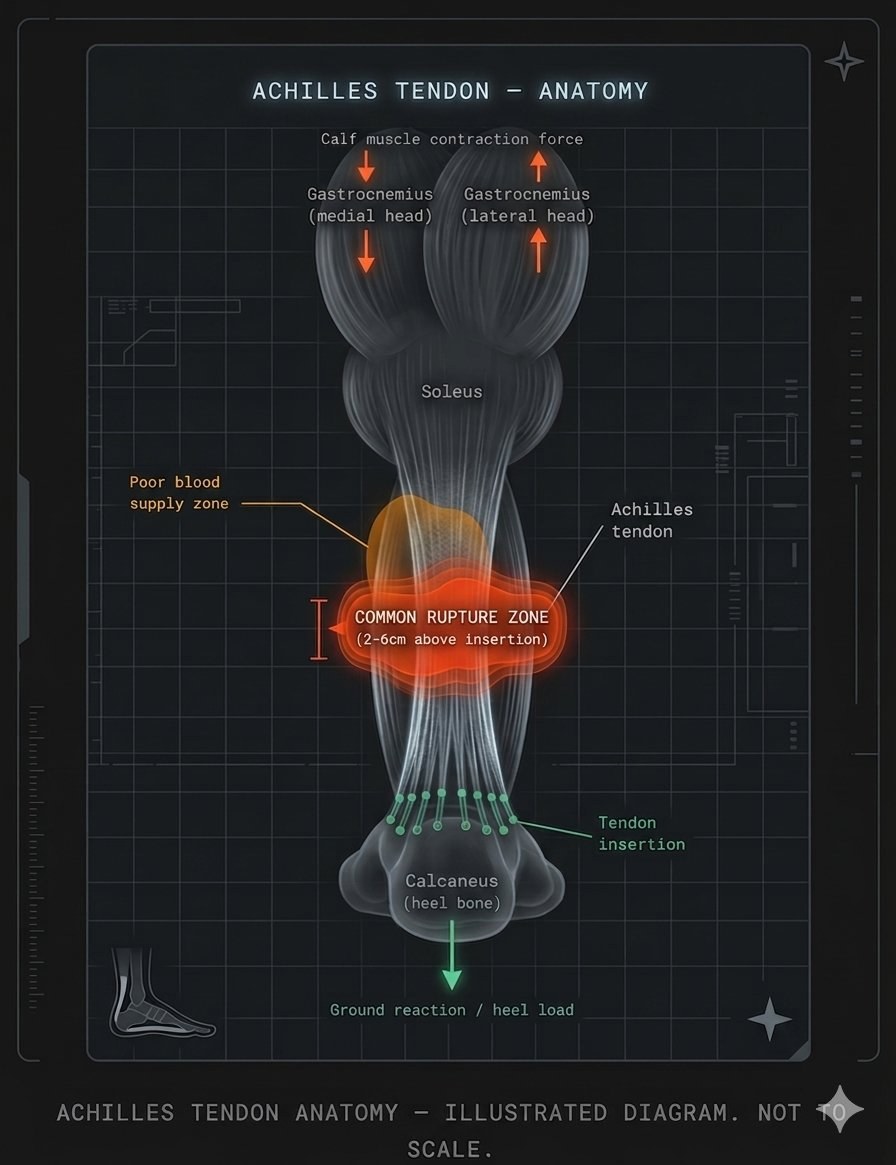
The Achilles tendon is the strongest and largest tendon in the human body. It connects the gastrocnemius and soleus calf muscles to the calcaneus (heel bone), and is responsible for plantarflexion — the movement that powers walking, running, and jumping.
Ruptures most commonly occur 2–6cm above the heel insertion point, in a zone of relatively poor blood supply. This is why healing is slow and why the early weeks of immobilization are critical.
"The information I needed most was scattered across research papers, Reddit threads, and clinician websites that contradicted each other."
The Achilles Hub was built by someone navigating an Achilles tendon rupture in real time — frustrated by the gap between what clinical literature says and what most health websites actually tell you.
Every page is compiled from peer-reviewed research and published clinical guidelines. Sources are cited. Information is distinguished clearly from advice. Nothing is written to sell you something — affiliate links are clearly disclosed where they exist.
About this site →A 3–5× rise over 25 years across multiple countries. The weekend warrior effect, ageing active populations, and more.
Scar massage, calf massage, oedema drainage, and cross-friction — what the evidence says about each technique.
How BFR training works, when it's appropriate during Achilles recovery, and what the research actually shows.
Taking collagen with vitamin C 30–60 minutes before exercise can more than double tendon collagen synthesis.
What tendon elongation means, why it happens, how much is normal, and what the evidence says about outcomes.
Instrument-assisted soft tissue mobilisation — what it is, when it's used, and what the evidence shows.
A practical look at blood flow restriction training during Achilles recovery — what sessions actually feel like.
How much stress does stationary cycling place on the healing Achilles compared to walking in a boot?
The most widely used clinical test for Achilles tendon integrity — how it works and why it can produce false negatives.
What non-, partial, and full weight bearing mean in practice, and how the progression typically works.
Legal, practical, and safety considerations — left foot, right foot, automatic and manual.
What the evidence says about photobiomodulation for tendon healing — promising, but limited.
The psychological side of a long injury — anxiety, identity loss, and strategies that actually help.
Collagen, creatine, omega-3, protein, and PRP — what the research supports and what it doesn't.
A phase-by-phase guide to what happens from injury to return to sport — and what to expect at each stage.
Why recreational athletes in their 30s–50s are disproportionately affected, and what the biology shows.