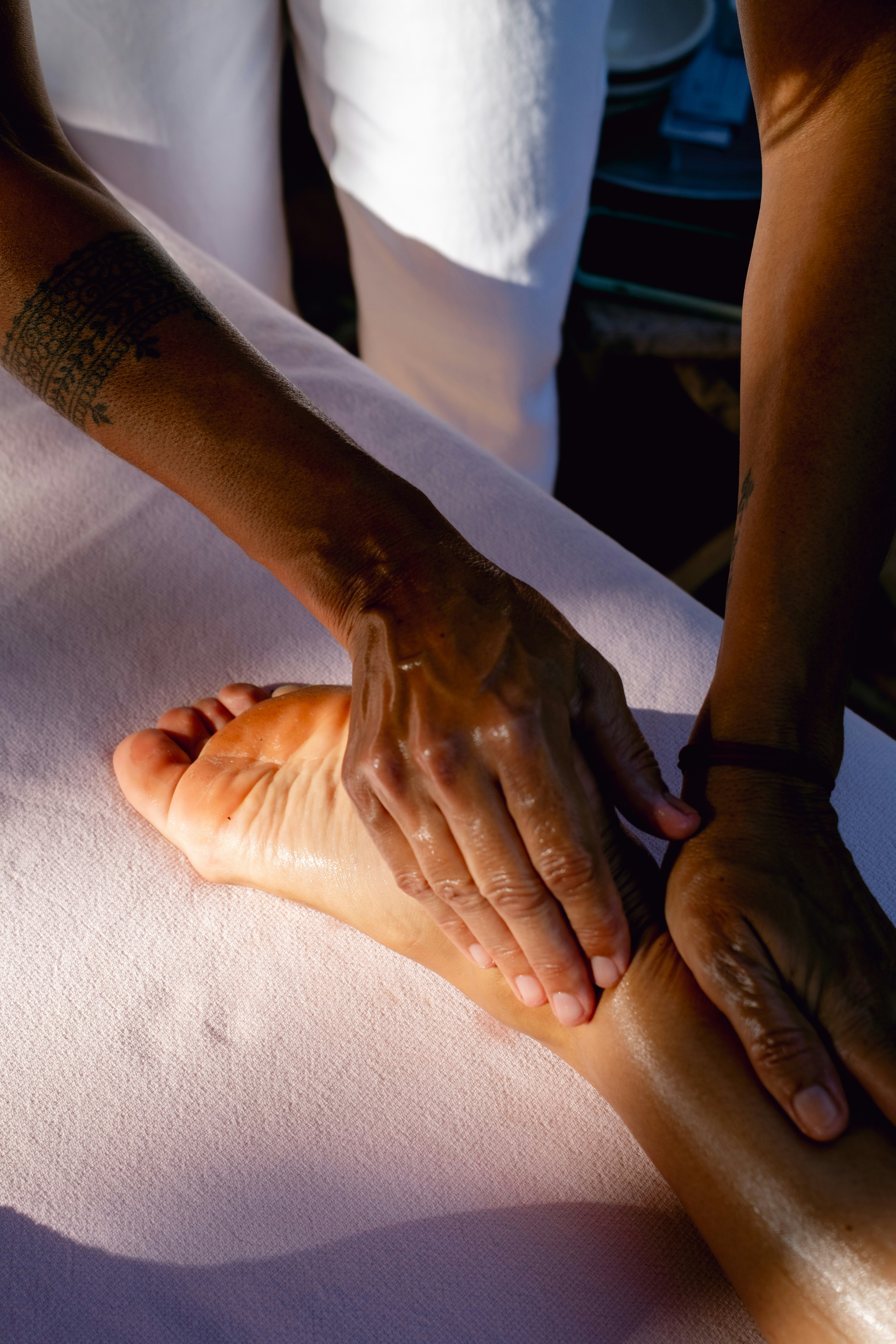
Massage is one of the most instinctive responses to injury — the urge to rub, press, and work the area around an injury is almost universal. During Achilles rupture recovery, patients regularly ask about massage: whether it helps, when it is safe, which techniques are appropriate, and whether the popular cross-friction method is actually useful.
The honest answer is that massage during Achilles recovery covers several quite different things — scar massage after surgery, calf muscle work, oedema drainage, and tendon-specific techniques — each with different evidence, different timing, and different risks. Lumping them together leads to confusion. This article covers each one separately.
The tendon is the priority. Everything else is secondary. During the boot phase especially, no soft tissue work — however well-intentioned — should compromise tendon protection. The ankle must remain in its prescribed position. Nothing should pull the healing repair into dorsiflexion. Massage to the calf or scar is an add-on to your rehabilitation, not a substitute for it.
What Is Actually Happening in the Tissue
To understand what massage can and cannot do during Achilles recovery, it helps to understand what the tissue is doing at each stage.
In the first two weeks after rupture or surgery, the area is in the inflammatory phase. The body floods the injury site with fluid, white blood cells, and signalling molecules. This is a necessary process — inflammation is not pathological at this stage, it is the beginning of repair. Massage during this phase risks increasing inflammation, disrupting the early clot that is forming at the repair site, and — for surgical patients — threatening wound integrity before closure is complete. No massage directly at the injury site is appropriate in this phase.
From approximately weeks two to six, the proliferative phase begins. New collagen is being laid down — but it is disorganised, immature type III collagen rather than the load-bearing type I collagen that makes up a healthy tendon. The repair is structurally vulnerable. Excessive mechanical stress, including aggressive massage directly on the tendon, can disrupt this process. The surgical wound, if present, is closing during this phase — and scar massage can begin carefully once full wound closure is confirmed.
From approximately weeks six onwards through to twelve months or more, remodelling occurs. Collagen gradually matures and reorganises. The scar becomes progressively more pliable. Calf muscle atrophy from weeks of disuse becomes a priority to address. This is when the majority of massage-related interventions become appropriate and useful.
Technique by Technique
After open or minimally invasive Achilles surgery, a scar forms along the incision line. As the scar matures, it can adhere to the underlying tendon sheath, skin, and soft tissue — creating tethering that limits ankle mobility, causes sensitivity, and in some cases affects the appearance and feel of the scar long-term.
Scar massage — gentle mechanical mobilisation of the scar and surrounding tissue — is the primary tool for preventing and reducing this adhesion during the remodelling phase. The evidence base is modest but supportive: massage forces can influence the remodelling of collagen during scar maturation, reducing the fibrosis response, improving elasticity, and limiting the degree to which the scar binds to deeper tissue. A case study published in the Journal of Surgical Case Reports demonstrated that tension offloading from the incision line produced a noticeably flatter, less hyperpigmented scar compared to the untreated portion of the same incision.
How to perform scar massage: Once the wound is fully closed — no open areas, no scabbing, no weeping — use a small amount of oil or moisturiser (vitamin E oil, bio-oil, or plain coconut oil all work) and apply light circular pressure across and around the scar. The goal is not deep pressure — it is consistent gentle mobilisation that keeps the skin mobile relative to the tissue underneath. Start with 5–10 minutes, two to three times daily. As the scar matures, progress to lifting the skin slightly away from the underlying tendon sheath using a pinching action. If this is painful or the scar is still very sensitive, reduce pressure and build gradually.
What to avoid: Do not begin scar massage before wound closure is confirmed by your clinical team. Do not use aggressive pressure on a fresh scar. Do not attempt scar mobilisation if you notice redness spreading from the wound, discharge, increasing pain, or warmth — these require clinical review, not massage.
The gastrocnemius and soleus muscles of the calf undergo significant atrophy during the boot phase. Weeks of reduced loading, combined with the altered gait pattern of boot walking, leaves the calf tight, knotted, and substantially weaker than before injury. Calf massage does not replace progressive loading exercise — nothing does — but it serves a useful complementary role in managing muscle tension, reducing discomfort, and maintaining circulation during the period when direct loading of the calf is still limited.
Massage to the calf belly is appropriate from around the six-week mark for most patients, and in some protocols from earlier. The goal is to address the tightness and trigger points that accumulate in a muscle that is chronically underloaded but still contracting with each step in the boot. Techniques include effleurage (long, gliding strokes up the length of the calf), petrissage (kneading the muscle belly), and focused pressure on trigger points — areas of localised tension that refer pain when pressed.
Important boundary: Calf massage should remain well above the Achilles tendon insertion — at the muscle belly, not the musculotendinous junction or the tendon itself. The tendon and the area immediately around it is not the target. Massage well up into the muscle, not down toward the heel.
As recovery progresses and strength training intensifies, calf massage between sessions can assist with recovery and reduce delayed-onset muscle soreness (DOMS). A foam roller or massage ball applied to the calf belly is a practical self-treatment option, though direct pressure over the tendon itself should continue to be avoided.
Swelling around the ankle and lower leg is almost universal after Achilles rupture, and it persists well into the boot phase. It is partly inflammatory, partly gravitational — the foot spends hours each day in a dependent position, and fluid pools. Persistent oedema is uncomfortable, limits ankle mobility as recovery progresses, and can delay wound healing in surgical patients.
Gentle lymphatic drainage massage — light upward strokes from the foot toward the knee, following the lymphatic vessels — can assist fluid return and reduce swelling. This does not require professional technique to be useful; simple elevation-combined-with-light-stroking from foot to knee is effective. The pressure is light — lighter than most people expect. The goal is to encourage lymphatic fluid movement, not to compress deep tissue.
This type of massage is appropriate from very early in recovery — even in the first week, if the wound is intact and sutured. It can be performed by a partner or by the patient on the accessible portions of the lower leg. Combine with elevation (foot above heart level) for maximum effect.
Persistent or severe oedema that does not respond to elevation and light drainage massage warrants clinical review. Unilateral lower-leg swelling combined with calf pain or heat can be a sign of deep vein thrombosis (DVT), which is a known risk after Achilles rupture and surgery — seek immediate medical review if this is suspected.
Cross-friction massage — also called transverse friction massage or deep transverse friction — is a technique in which the thumb or fingers apply firm pressure perpendicular to the tendon fibres, working across rather than along the tendon. It is widely used and promoted for Achilles tendinopathy and tendinitis, particularly in sports massage circles, with claims that it breaks down scar tissue, realigns collagen fibres, and improves blood flow to the tendon.
For Achilles rupture recovery, the evidence does not support cross-friction massage applied directly to the healing tendon — and the theoretical case for it is weaker than commonly claimed.
First, the evidence for cross-friction massage even in tendinopathy (a very different condition to rupture) is poor. The most authoritative review, a Cochrane systematic review of deep transverse friction massage for tendinitis, concluded that evidence of benefit is of very low quality — it is uncertain whether the technique improves pain and function even in the conditions where it is most commonly applied.
Second, the mechanism often cited — "breaking down scar tissue" within the tendon — does not straightforwardly apply to Achilles rupture. Clinician Maryke Louw, writing for Treat My Achilles, notes that the lump felt in a tendinopathic tendon is not scar tissue at all, but disorganised cells — and that the scar tissue narrative around tendon problems is often oversimplified. In a healing rupture, the new tissue being formed is structurally vulnerable for months. Aggressive transverse pressure applied directly to it is not benign.
Third, and most practically: direct pressure on the healing Achilles tendon in the first 12 weeks post-injury risks disrupting the repair, increasing inflammatory load, and potentially contributing to the adhesion of the tendon to surrounding structures — the opposite of the claimed benefit.
There may be a role for very gentle transverse mobilisation of the scar and peritendinous tissue — distinct from aggressive cross-friction on the tendon itself — later in rehabilitation under physiotherapist guidance. But the popular version of cross-friction massage as a self-administered technique applied forcefully to the tendon during recovery is not supported for Achilles rupture patients.
The plantar fascia, the arch of the foot, and the intrinsic foot muscles are often neglected during Achilles recovery — but they are the structures that will need to absorb load when the boot comes off and progressive weight-bearing resumes. Gentle foot massage, particularly to the arch and plantar fascia, can be performed from early in recovery and is useful for maintaining circulation, reducing stiffness in the foot and toes, and keeping the plantar structures pliable.
A small massage ball or golf ball rolled slowly under the arch of the foot (not under the heel, which avoids the Achilles insertion) can be effective and is easily self-administered. This is appropriate throughout the boot phase and into the transition to normal footwear.
Instrument-assisted soft tissue mobilisation (IASTM) is a manual therapy technique that uses specially designed tools — typically bevelled metal or plastic instruments — to apply controlled mechanical pressure to soft tissue. In the context of Achilles recovery, it is sometimes used to address fascial restrictions, scar tissue adhesion, and muscle tension around the calf and lower leg during the remodelling phase.
IASTM works on a similar principle to manual soft tissue massage but allows the clinician to detect and treat areas of altered tissue texture with greater specificity. The instrument edge transmits tactile feedback about tissue quality that can be difficult to appreciate through hands alone. When applied to the calf and peritendinous tissue, the goal is to break down restrictive adhesions and stimulate a localised healing response — increasing fibroblast activity, improving local circulation, and reducing fascial tethering around the repair site.
The evidence base for IASTM in Achilles tendon pathology is modest and largely derived from tendinopathy rather than rupture, so direct applicability to rupture recovery is limited. However, physiotherapists experienced in post-surgical Achilles rehabilitation do use IASTM as part of manual therapy protocols from approximately 12 weeks onwards, once the tendon repair is sufficiently mature. It is not appropriate in the early phases of recovery and should never be applied directly over an immature scar or healing repair site.
Important: IASTM should only be performed by a qualified physiotherapist or sports medicine clinician trained in the technique. It is not a self-treatment and carries risk of tissue damage if applied incorrectly — particularly to a healing Achilles tendon. If you are interested in IASTM as part of your rehabilitation, discuss it with your treating physiotherapist. See our full explainer: IASTM in Achilles Recovery →
A Phase-by-Phase Summary
When to Stop and Seek Review
Stop any massage immediately and contact your clinical team if you notice:
- Wound reopening, discharge, or spreading redness around the surgical scar
- A sudden increase in pain or swelling at the tendon site after soft tissue work
- New or worsening calf pain combined with swelling and warmth — potential DVT
- Numbness, tingling, or altered sensation in the foot or lower leg
- Any feeling of giving way, popping, or structural instability at the ankle
Deep vein thrombosis (DVT) is a known risk after Achilles rupture and surgery, particularly in the first 4–6 weeks. If you develop sudden, new, unilateral calf swelling, warmth, or pain — seek urgent medical review. Do not massage a leg in which DVT is suspected. Massage can dislodge a clot. This is a medical emergency pathway, not a home management situation.
The Role of a Sports Massage Therapist or Physiotherapist
Self-massage has a meaningful place in Achilles recovery — particularly scar massage and light calf work — but it has limits. A qualified sports massage therapist or physiotherapist can assess the tissue, identify areas of adhesion, and apply techniques with appropriate pressure and precision that is difficult to achieve through self-treatment alone.
From around six weeks post-surgery, many physiotherapy protocols incorporate manual therapy as a component of rehabilitation — joint mobilisation, soft tissue release, and targeted muscle work to complement the exercise programme. This is distinct from lay cross-friction massage: it is clinician-led, assessed against your current healing stage, and adjusted based on tissue response.
If you are using a sports massage therapist independently of your physiotherapy, ensure they are fully briefed on your injury, your surgical approach, and your current rehabilitation stage. A therapist unfamiliar with Achilles rupture may apply techniques — including aggressive tendon friction — that are not appropriate at your stage of healing. Communication between practitioners is important.
Evidence for massage specifically in Achilles rupture recovery is limited. Most studies address tendinopathy (a different condition) or general post-surgical scar management. Claims in this article are matched to the strongest available evidence and caveated where evidence is weak or indirect.
- Thetis Medical. When to Start Scar Massage After Achilles Surgery. 2026. thetismedical.com — Clinical guidance on timing and technique for scar massage post-Achilles surgery; discusses wound closure as the threshold for starting scar work, typical ~2-week review checkpoint, red flags to stop.
- Fong JH, Sibbald RG, Wu C et al. Is massage an effective intervention in the management of post-operative scarring? A scoping review. — Scoping review on post-operative scar massage evidence; cited as foundation for scar massage protocols in Achilles surgery rehabilitation.
- Conde E. Compression therapy and scar massage in post-traumatic and post-surgical leg wounds. 2019. elenaconde.com — Discusses mechanism of scar massage: massage forces influence extracellular matrix proteins, induce fibroblast apoptosis, limit collagen overproduction, and reduce adhesion to deep tissues; lymphatic drainage reduces oedema and swelling.
- Gillies H, Holt L. Tension offloading improves cutaneous scar formation in Achilles tendon repair. Journal of Surgical Case Reports. 2022;3:rjac066. Oxford Academic — Case report demonstrating that tension offloading of the incision scar post-Achilles repair produced a flatter, less hyperpigmented scar compared to the untreated portion of the same incision.
- Brosseau L et al. Deep transverse friction massage for the treatment of lateral elbow or lateral knee tendinitis. Cochrane Database of Systematic Reviews. 2002, updated. Cochrane — Systematic review concluding that evidence of benefit from deep transverse friction massage for tendinitis is of very low quality; uncertain whether it improves pain and function.
- Louw M. Don't do cross frictions massage on your Achilles tendon. Treat My Achilles. 2025. treatmyachilles.com — Clinician explanation of why the "scar tissue" narrative around Achilles problems is often inaccurate, and why cross-friction massage is not supported for tendon conditions.
- The Massage Therapist Development Centre. Massage Therapist Treatment For An Achilles Tendon Rupture. 2020. themtdc.com — Clinical framework for massage therapist involvement in Achilles rupture recovery; notes that manual therapy around the tendon and calf muscles is appropriate from approximately the six-week mark, with goal of increasing ankle range of motion.
- Bitterman A et al. Rehabilitation and Return to Sports after Achilles Tendon Repair. International Journal of Sports Physical Therapy. 2024. PMC11379499 — Comprehensive rehabilitation commentary; notes that passive Achilles or gastrocnemius stretching should be avoided for the first 12 weeks; provides rehabilitation sequence context for when manual therapy is appropriate.