Resistance Bands for Achilles Rehabilitation
Resistance bands are a core tool of Achilles tendon rehabilitation — used for ankle range-of-motion exercises, progressive calf loading, and proprioceptive training throughout the recovery arc. Having the right set of resistances from the start makes the programme easier to follow at home.
Resistance bands enter Achilles rehabilitation in two distinct phases. In the early rehabilitation phase — typically after boot removal — light bands are used for ankle plantarflexion, dorsiflexion, inversion, and eversion exercises that restore range of motion and begin loading the calf and Achilles complex without full bodyweight. These are performed seated, with the band providing the resistance rather than gravity.
In the progressive loading phase, bands are used to add resistance to calf raise variations — seated calf raises with band resistance, standing calf raises with band assistance or resistance, and eventually exercises that replicate sport-specific loading patterns. The progression from lighter to heavier bands mirrors the tendon's increasing load tolerance as it remodels and strengthens.
Resistance band exercises for Achilles rehabilitation must be introduced and progressed under physiotherapist guidance. Loading the tendon too early or too aggressively is one of the most common causes of setbacks during recovery. The exercises prescribed, the resistance levels used, the volume, and the timing of progression should all be determined by your treating physiotherapist — not self-directed.
Resistance Level Guide
Theraband colour coding is the clinical standard for resistance bands and is used by most physiotherapy programmes. The progression for Achilles rehabilitation typically starts at yellow or red and advances as tolerated:
The Options
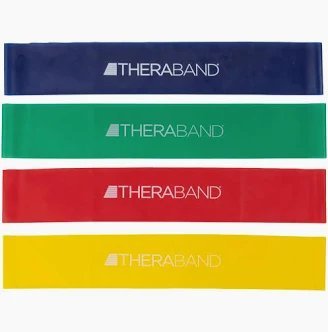
Theraband is the original clinical resistance band brand and remains the gold standard used in physiotherapy clinics globally. The flat band format is the most versatile for Achilles rehabilitation — it can be tied into loops for ankle exercises, wrapped around the foot for plantarflexion and dorsiflexion work, anchored to a door or furniture leg, or cut to custom lengths. The resistance progression is consistent and colour-coded in the standard clinical system.
For Achilles rehabilitation, a set covering yellow through blue provides the full range needed from early ankle mobilisation through progressive calf loading. The professional-grade latex construction is more durable and consistent than generic flat bands, which vary significantly in their actual resistance across the stretch range. Available in rolls (most economical for extended use) or pre-cut lengths. Latex-free versions are available for patients with latex sensitivity.
- Clinical gold standard — used by physiotherapists
- Consistent, calibrated resistance across colours
- Flat format — most versatile for ankle exercises
- Latex-free option available
- Durable — outlasts generic alternatives
- Flat bands require tying for loop exercises
- Can roll or bunch during use without anchor
- Higher cost than generic alternatives
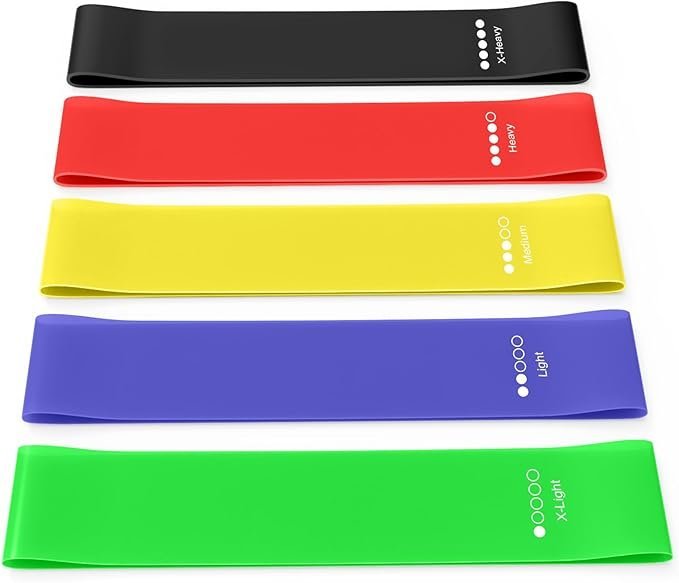
Loop resistance bands — pre-formed circles in a set of five resistance levels — are the most convenient format for many Achilles rehabilitation exercises. They are immediately ready to use without tying, and the loop format suits exercises like ankle eversion, inversion, and calf raises with band anchoring around the foot. Sets from brands such as Fit Simplify, WOD Nation, or Perform Better cover the full resistance range from very light through heavy.
The trade-off compared to flat therabands is that latex loop bands can roll and dig into the ankle during use, and the resistance progression between sizes is less precisely calibrated than clinical Theraband. For patients following a home programme prescribed by their physiotherapist, a quality 5-piece loop set covers all required exercises at a lower cost than Theraband rolls. Fabric loop bands (discussed below) address the rolling and digging issue.
- Immediately ready — no tying
- Full resistance range in one set
- Lower cost than Theraband
- Compact — easy to store and travel with
- 5-piece sets widely available
- Can roll and dig into ankle during use
- Less precise calibration than Theraband
- Shorter lifespan than clinical-grade bands
- Less versatile than flat bands
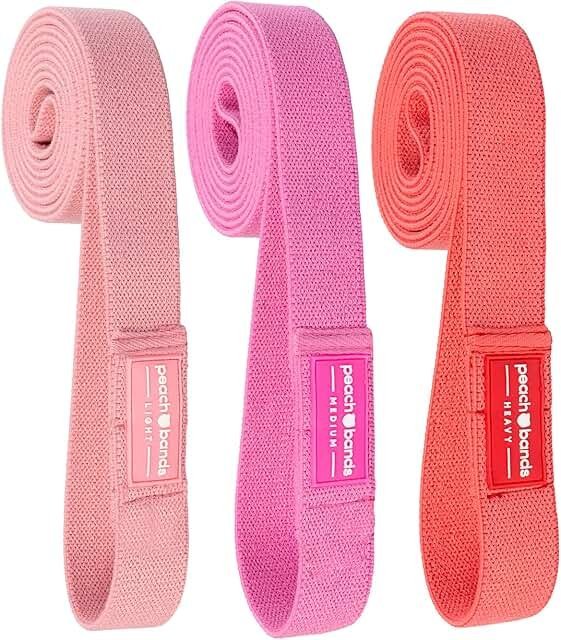
Fabric (cloth) resistance bands solve the primary discomfort of latex loop bands — rolling, pinching, and digging into skin during ankle exercises. The woven fabric construction stays flat against the ankle and lower leg regardless of movement, making them significantly more comfortable for exercises where the band sits directly against bare skin for extended periods.
Brands such as Banded, Peach Bands, and Undersun produce fabric resistance band sets in 3–5 resistance levels. The maximum resistance is generally lower than heavy latex bands, making them most appropriate for early to mid-rehabilitation exercises rather than high-load progressive work. For patients with sensitive skin, latex allergy, or who find standard loop bands uncomfortable during ankle exercises, fabric bands are a practical and comfortable alternative.
- Does not roll or dig into ankle
- Comfortable on bare skin
- Naturally latex-free
- Stays in position during exercises
- Lower maximum resistance than latex
- Less versatile than flat therabands
- Higher cost than latex loop sets
- Not suitable for high-load later rehab stages
Side by Side
| Option | Format | Resistance range | Ankle comfort | Latex-free option | Price |
|---|---|---|---|---|---|
| Theraband Professional | Flat roll / cut lengths | ✓ Full clinical range | ✓ Good | ✓ Available | $$ |
| Loop Band Set (latex) | Pre-formed loops | ✓ Light to heavy | Can roll/dig | Most are latex | $ |
| Fabric Band Set | Pre-formed loops | Light to medium only | ✓ Excellent | ✓ Yes — fabric | $$ |
Achilles rehabilitation progresses across multiple resistance levels over weeks and months. Buying a single band at the resistance level your physiotherapist starts you on leaves you without the next progression when you need it. Buy the full set (yellow through blue for Theraband, or a 5-piece loop set) at the beginning. The cost difference between a single band and a set is small, and having the progression ready removes a friction point when your programme advances.